

South Korea Imaging Radar and SAR Test Platforms Market Grows; Keysight, Rohde Lead
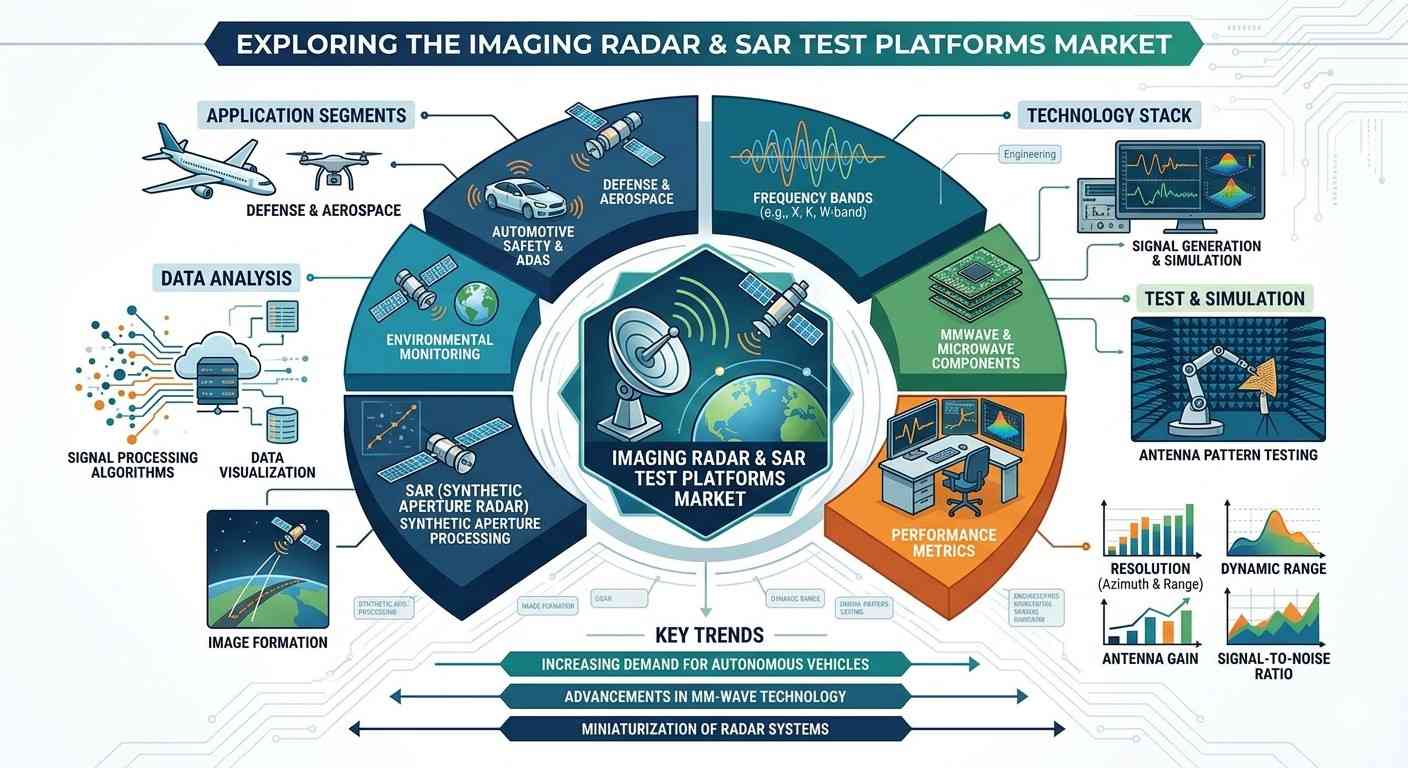
Imaging Radar and SAR Test Platforms Market
HIL simulation and 6G integration boost defense testing demand
ROCKVILLE, MD, UNITED STATES, April 16, 2026 /EINPresswire.com/ -- According to the latest market analysis by Fact MR, the South Korea Imaging Radar and Synthetic Aperture Radar (SAR) test platforms market is entering a high-velocity expansion phase. As the nation accelerates its indigenous defense programs and aerospace ambitions, the demand for sophisticated validation infrastructure has moved from a secondary requirement to a primary strategic asset.The South Korea market is currently valued at USD 940 million in 2026 and is projected to soar to USD 2.20 billion by 2036. This trajectory represents a robust CAGR of 8.8%, creating an incremental opportunity of USD 1.26 billion over the next decade. The transformation is primarily fueled by the South Korean government’s push for localized satellite constellations and advanced airborne ISR (Intelligence, Surveillance, and Reconnaissance) capabilities.
Get detailed market forecasts, competitive benchmarking, and pricing trends:
https://www.factmr.com/connectus/sample?flag=S&rep_id=13164
Quick Stats Section
Market Size (2026): USD 0.94 Billion
Market Size (2036): USD 2.20 Billion
Forecast CAGR:8%
Incremental Opportunity: USD 1.26 Billion
Leading Segment: HIL (Hardware-in-the-Loop) / Scene Simulators (30% Share)
Dominant End-User: Defense Primes (40% Share)
Regional Focus: South Korea (Core Growth Hub)
Key Players: Rohde & Schwarz, Keysight Technologies, Anritsu, Spirent Communications, dSPACE, NI (National Instruments), Ansys.
Executive Insight for Decision Makers
The South Korean market is witnessing a fundamental strategic shift from static laboratory testing to dynamic, real-time Hardware-in-the-Loop (HIL) environments. For OEMs and investors, the message is clear: the era of "good enough" radar calibration is over.
To remain competitive, manufacturers must integrate AI-driven scene generation into their test benches to simulate complex urban environments and electronic warfare (EW) scenarios. Failure to adapt to these high-fidelity simulation requirements risks obsolescence, as the South Korean Ministry of National Defense (MND) tightens regulatory compliance for next-generation SAR payloads and autonomous systems.
Market Dynamics
Key Growth Drivers:
Indigenous Defense Programs: Rapid development of the KFX fighter jet and local satellite constellations.
Technological Convergence: The merging of 6G communication research with radar sensing.
Automation: A shift toward automated testing to reduce human error and operational costs.
Key Restraints:
High Capital Expenditure: Significant initial investment for multi-frequency test chambers.
Integration Complexity: Challenges in synchronizing legacy hardware with modern software-defined simulators.
Emerging Trends:
Cognitive Radar Testing: Platforms capable of testing adaptive, learning radar systems.
Digital Twins: Using virtual replicas of the South Korean terrain for SAR algorithm validation.
Segment Analysis
The HIL or Scene Simulators segment holds a commanding 30% share of the market in 2026. This dominance is due to the segment’s ability to replicate real-world "noise" and environmental clutter in a controlled setting. Defense Primes remain the largest end-users (40%), though the Commercial SAR Operators segment is identified as the fastest-growing sub-sector, driven by the rise of private Earth observation startups in Seoul and Daejeon.
Supply Chain Analysis: The Ecosystem of Precision
The South Korean supply chain is highly specialized:
Raw Material & Component Suppliers: Focus on high-frequency semiconductors (GaN) and RF components.
Manufacturers/Producers: Global giants like Keysight and Rohde & Schwarz provide the core instrumentation, often partnering with local tech integrators.
Distributors: Specialized Korean agencies that provide localized support and software customization.
End-Users: Primarily Hanwha Systems, LIG Nex1, and the Agency for Defense Development (ADD).
Who Supplies Whom: Tier-1 test equipment providers supply modular platforms to Defense Primes, who then utilize these systems to validate the radar sub-assemblies provided to the military for final aircraft or satellite integration.
Pricing Trends
The market operates on a Premium-Tier Pricing model. Unlike commodity electronics, imaging radar test platforms are priced based on frequency coverage (X-Band vs. Ka-Band) and real-time processing bandwidth.
Margin Insights: High margins are sustained through long-term software maintenance contracts and periodic hardware upgrades to support newer frequency bands.
Regional Analysis: South Korea in Focus
While China leads the broader Asia-Pacific region with a 10.5% CAGR, South Korea's 8.8% CAGR is distinguished by its high density of high-tech defense R&D.
Why South Korea Grows: Unlike emerging markets focused on low-cost radar, South Korea is a "mature-innovation" market. The growth is concentrated in the Gyeonggi and Daejeon clusters, where aerospace and military research is most intensive.
Competitive Landscape
The market is consolidated among a few global leaders who possess the IP for high-frequency signal generation.
Strategies:Keysight Technologies is focusing on modularity and software-defined architectures. Rohde & Schwarz continues to dominate through hardware precision and integrated EW (Electronic Warfare) testing capabilities. dSPACE and Ansys are gaining ground by bridging the gap between physical testing and virtual simulation.
Strategic Takeaways
For Manufacturers: Prioritize multi-band compatibility (C, X, and Ku-band) within a single platform to maximize value for Korean defense primes.
For Investors: Look toward software-as-a-service (SaaS) models within the simulation space, as recurring revenue from algorithm updates becomes a major profit driver.
For Marketers: Emphasize "Regulatory Compliance" and "Speed-to-Market" as key value propositions for South Korean R&D labs.
Future Outlook
By 2036, the integration of Quantum Sensing and Sustainability-focused SAR (for climate monitoring) will redefine the market. We expect a long-term transition toward cloud-based test data management, allowing South Korean engineers to collaborate across decentralized R&D centers in real-time.
Conclusion
The South Korea Imaging Radar and SAR test platforms market is not just growing; it is evolving. For decision-makers, the transition from hardware-centric testing to software-driven, automated simulation is the only path to maintaining strategic parity in a rapidly changing regional security landscape. The opportunity lies in the intersection of high-fidelity simulation and indigenous innovation.
Full Report: Unlock 360° insights for strategic decision making and investment planning-
https://www.factmr.com/checkout/13164
To View Related Report:
Thermal Imaging Components Market https://www.factmr.com/report/thermal-imaging-components-market
Quantum Imaging Devices Market https://www.factmr.com/report/quantum-imaging-devices-market
Document Imaging Market https://www.factmr.com/report/document-imaging-market
Hyperspectral Imaging Market https://www.factmr.com/report/4570/hyperspectral-imaging-market
S. N. Jha
Fact.MR
+ +1 628-251-1583
email us here
Legal Disclaimer:
EIN Presswire provides this news content "as is" without warranty of any kind. We do not accept any responsibility or liability for the accuracy, content, images, videos, licenses, completeness, legality, or reliability of the information contained in this article. If you have any complaints or copyright issues related to this article, kindly contact the author above.
